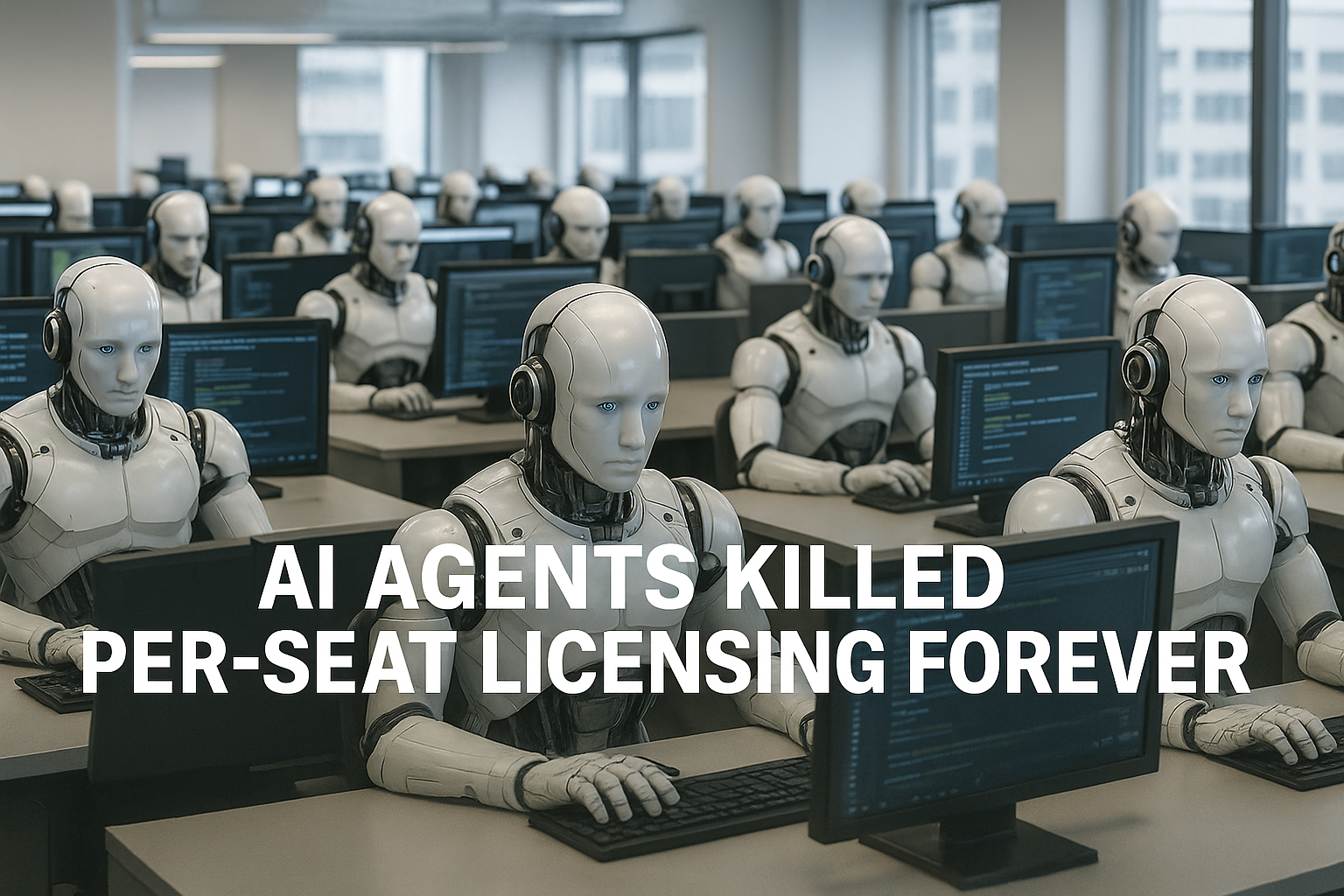

I watched the entire SaaS pricing model collapse during a single client engagement.
We doubled their revenue by optimizing operations and decentralizing their systems. The moment I saw the results, something clicked.
They weren't paying for software access. They were paying for outcomes.
The traditional per-seat model charges companies based on how many people log in, not how much value the system delivers. It's a tax on headcount instead of a multiplier of output.
When you help a business triple customer bookings or cut IT costs by 78%, nobody cares how many seats they have. They care about transformation.
The collapse became inevitable the moment AI matured enough to automate what used to require dozens of human users. When a single AI instance can do the work of five departments, the per-seat model makes zero sense.
You don't need more users. You need more intelligence.
The Permission Economy Is Dead
For twenty years, software costs have been tied to people, not performance.
It's a relic from when digital tools were just digital desks. Microsoft licenses, email accounts, CRMs. Things you "gave" to employees.
But modern companies don't scale through people logging into systems. They scale through intelligence distributed across systems.
The numbers prove it. Usage-based pricing adoption jumped to 78% of companies in just the last five years, with nearly half adopting in the last two years alone.
That's not a trend. That's a migration.
Meanwhile, 68% of vendors now charge separately for AI enhancements or bundle them exclusively in premium tiers. The old pricing architecture is fracturing in real time.
I tell CFOs this directly: "You're not budgeting for software anymore. You're budgeting for speed."
Decision speed. Customer speed. Execution speed.
Why Most AI Implementations Fail
The technical barrier isn't AI capability. It's data authority.
Which system is the source of truth? Which system is allowed to act on behalf of the business?
The minute that's unclear, agent-to-agent orchestration breaks.
Finance lives in QuickBooks, sales in HubSpot, ops in a homegrown spreadsheet, customer intel trapped in email or Slack. None of those systems were designed to publish standardized, real-time states for an AI agent to reason over.
That's why in AIBMOS rollouts we first decentralize company intel and make it universally accessible. Once the intel flows, AI can actually do something with it.
When we did that, clients cut IT spend by 78% and their teams could respond from anywhere because data wasn't locked in silos.
Most stacks were built user-first, not agent-first. You've got role-based access control that assumes "Jill in operations" but not "procurement-agent-01 calling finance on a Wednesday."
When agents start calling other systems, permission layers freak out because there's no consistent service identity.
That's also why per-seat pricing dies. The agent isn't a seat.
Everyone wants autonomous AI, but their stack is still request-response. Agents need event-driven environments. "Invoice posted." "Lead stuck 48 hours." "Margin dropped 3 points."
Technologies like real-time context engines using Kafka and Flink are solving this by enabling agents to monitor data streams and trigger automatically based on conditions.
No events, no choreography.
Pricing Intelligence Instead of Access
When your system becomes the execution layer, you can't price it like "$99 per user." That would punish customers for adopting AI well.
So we price around business throughput and owned outcomes.
We anchor to the annualized value the system can realistically unlock in the first 6 to 12 months. Revenue lift from removing friction. Hard-dollar savings from killing redundant tools. Productivity gains that improve cash flow.
For a $6M services company aiming for $20M in three to five years, it's not hard to find $250K to $750K in annualized value just from those three levers.
That number becomes the pricing ceiling. We never price above the value we can prove.
Then we scope orchestration domains. Ops orchestration. Revenue orchestration. Intel decentralization.
The more domains the system runs, the higher the price. That's how we separate a $2,500 monthly install from a $15,000 monthly operating system.
On initiatives where we can clearly attribute the lift, we attach 5% to 15% of the uplift for a fixed period. That's how we get paid like a partner, not a plugin.
I tell CFOs straight: "You've been paying for people to log in. I want you paying for parts of the business to run themselves."
The Security Threat Nobody's Preparing For
Everyone's obsessing over AI hallucinations and prompt injection. Those are surface-level risks.
The real existential threat is synthetic legitimacy. When a bad actor or rogue process feeds an AI network accurate-looking data that slowly retrains its decision logic without detection.
It's not hacking the OS. It's conditioning it.
In a world where AI is reading invoices, forecasting revenue, routing field techs, and approving vendor contracts, you don't need to breach the firewall. You just need to tilt the data stream a few degrees off center.
You poison the model not with malware, but with believability.
Traditional systems can be patched because they're rule-based. Agentic systems are belief-based. They operate from learned context and continuous reasoning loops.
Once you contaminate their data fabric, you're not just changing outputs. You're changing the philosophy of optimization.
That's why AIBMOS builds data authority hierarchies with row-level security and SOC2-grade isolation. Every data event is cryptographically linked to its origin.
We use behavioral anomaly detection, not just intrusion detection. The OS knows what "normal" looks like for each workflow.
When behavior deviates without a legitimate trigger, it flags decision drift.
Governance at Machine Speed
If you govern AI the old way with manual review boards and quarterly audits, you've already lost.
By the time you read the audit, the system has made 10,000 more decisions.
Governance has to move from static oversight to dynamic alignment. We don't audit the AI. We co-govern it in real time.
Every decision has a governance fingerprint attached the moment it's made. Who or what initiated it. What context and confidence score drove it. What policies applied at that moment.
Those fingerprints stream into a continuous ledger. Auditors subscribe to decision flows and get alerted when behavior deviates from policy.
It's the difference between policing and monitoring a heartbeat.
We handle this through three layers. An immutable decision ledger where every micro-decision is hashed and timestamped. Policy oracles that act as live guardrails. An adaptive governance engine that uses machine learning to detect when policies themselves are outdated.
Speed stays intact because auditing isn't external. It's embedded.
AIBMOS treats explainability as a feature, not a forensic tool. Every decision can be queried like a database.
Leaders aren't micromanaging transactions anymore. They're managing alignment. Their dashboard looks more like air-traffic control than a spreadsheet.
Green means operating within policy. Yellow means drift detected. Red means override required.
What Sounds Absurd Today
Five years from now, the thing that will sound absurd is this: we used to make billion-dollar decisions on gut feeling and PowerPoint slides.
That era's over.
By 2030, every competitive company will operate inside a thinking environment. A real-time cognitive layer that observes, reasons, and adjusts faster than humans can convene a meeting.
We'll look back at quarterly reviews, status reports, and email chains the way we look at fax machines today.
Leaders won't ask for reports. They'll ask for simulations. "Run three futures and tell me which one makes us money faster."
Decision velocity will eclipse decision authority. Speed will become the new management currency.
Companies will compete on decision cycle time, not headcount or capital.
The companies that survive won't be the ones that adopt AI first. They'll be the ones that clean the mirror before they ask it to think.
Here's the brutal truth I tell every client: if your business runs on spreadsheets, don't buy AI. Fix your operating system first.
Otherwise, you're just teaching the machine to manage your dysfunction faster.
Agentic systems aren't a shortcut to efficiency. They're an amplifier of whatever's true.
Good or bad.