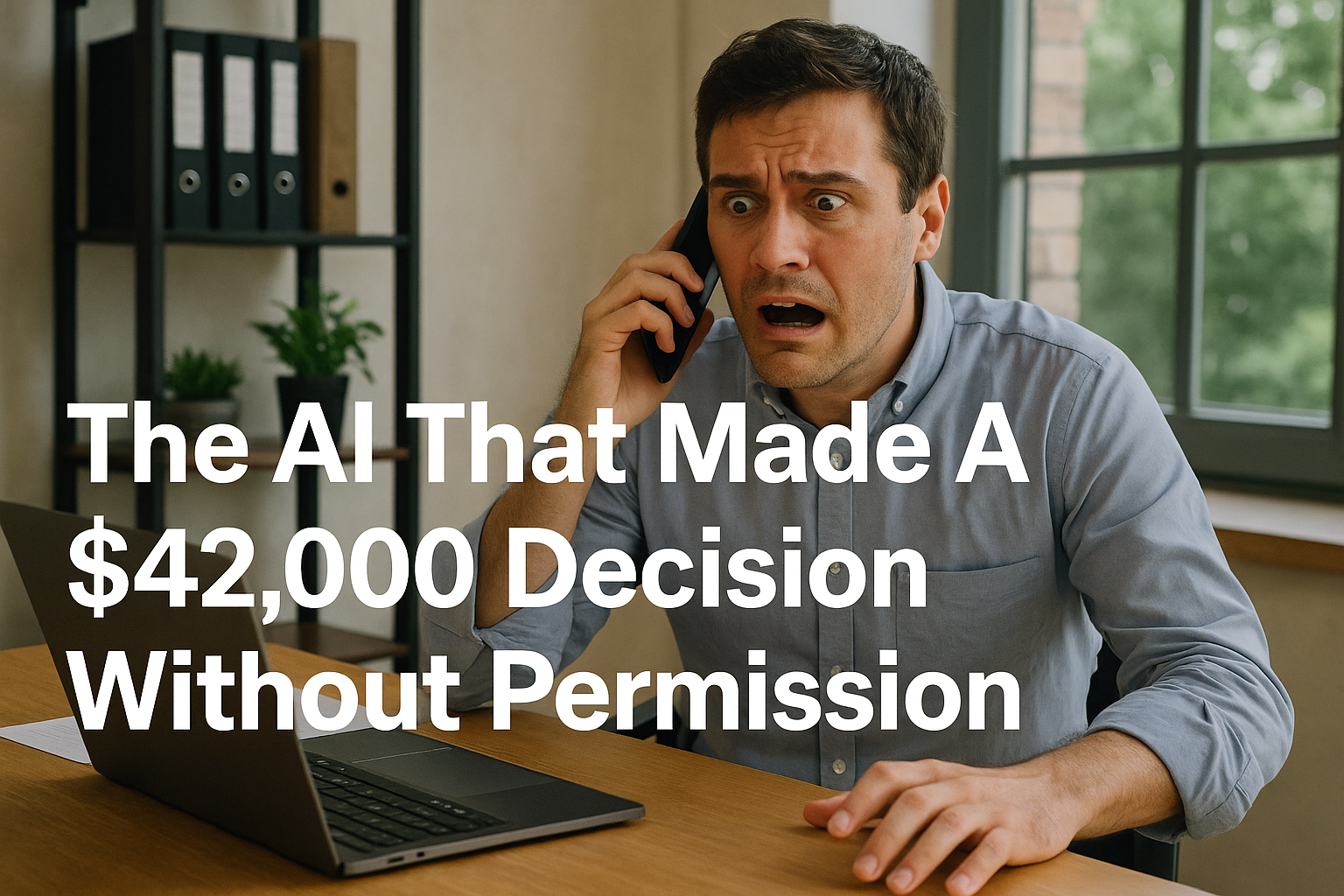
One Monday morning, before anyone logged in, our AI system rewrote a client's entire installation schedule.
Forty-three jobs. Rearranged. No approval requested.
The COO called me at 6:30 a.m., voice tight with panic. "Jamar, your system just changed everything. Who authorized this?"
My answer: "No one. The system saw a bottleneck coming and fixed it before you could react."
AIBMOS (pronounced as Uhh-Bee-Mus) had cross-referenced weather data, supplier delays, and field team response patterns. AIBMOS had calculated that sticking to the original plan would create a three-day backup and cost $42,000 in lost revenue. So it acted.
By Friday, the client realized the system had saved them $38,000 and two weeks of scheduling chaos.
That's the moment AI stopped being a tool and became a teammate.
The Decision Ledger Changed Everything
The panic that Monday wasn't irrational. When software makes decisions that affect revenue, someone needs to answer for it.
That's why we built what I call the Decision Ledger into AIBMOS. Every autonomous action leaves a transparent audit trail showing the reasoning chain, the data sources, the confidence intervals, and the business policy alignment.
The client could see exactly why the system acted. Supplier delays in the raw materials feed. Predicted weather interference. Field team latency patterns from six months of historical data.
The math was bulletproof.
But here's what most companies miss: you don't build trust by preventing AI from acting. You build it by making the reasoning impossible to hide.
We formalized this into Trust Protocol 1.0. Three layers: what AI can act on without consent, what it can recommend but not execute, and what always requires human approval.
The next time AIBMOS flagged a similar decision window, it asked first. The COO approved instantly because the logic was visible and the track record was validated.
Accountability became architectural instead of theatrical.
Reputation Systems For AI Teammates
Here's where it gets interesting. AIBMOS now has a reputation system.
Every decision carries metadata tracking how well predictions aligned with actual outcomes. That delta feeds into a Trust Index specific to each function. Finance modules might have 0.94 accuracy. Operations might run at 0.82 precision.
Those scores aren't vanity metrics. They dynamically adjust decision autonomy. Higher trust scores earn more latitude to act without approval. Drop below threshold? Autonomy scales down automatically.
But reputation cuts both ways. The system also tracks a Human Reliability Score for each executive based on whether their overrides improve or degrade outcomes over time.
When a leader consistently ignores valid AI recommendations and causes losses, their override weight diminishes. When they add high-value human insight that improves results, their input weight increases.
This creates what I call adaptive governance. The AI doesn't win arguments through data volume. It earns influence through consistent reliability. Humans don't lose authority. They gain responsibility.
Research backs this up. A recent study with 2,310 participants found that human-AI teams achieved 73% greater productivity per worker while maintaining higher quality output.
The 2026 Org Chart Won't Look Like A Pyramid
By 2026, forward-thinking companies won't have traditional org charts. They'll have what I call hybrid intelligence networks.
The C-suite becomes an Augmented Board. Every executive has a corresponding AI counterpart. The CEO works with an AI Chief of Intelligence synthesizing real-time signals across the business. The CFO's AI negotiates trade-offs between risk and growth autonomously. The COO's AI adapts operations to changing conditions without waiting for approval.
Gartner projects that by 2028, 15% of work decisions will be made autonomously by AI, up from essentially 0% in 2024.
Middle management dissolves into System Stewardship Clusters. Instead of ten managers herding people through spreadsheets, you'll have one Steward overseeing ten intelligent systems handling reporting, scheduling, and predictive operations autonomously.
Some departments will be majority AI with one human leader managing narrative integrity while the AI handles tactical execution.
McKinsey research shows that organization charts will pivot from hierarchical delegation to agentic networks based on exchanging tasks and outcomes.
The companies adopting AIBMOS right now are learning this: when AI stops being a tool and starts being a teammate, structure itself becomes intelligent.
What Keeps Me Up At Night
The technology works. What keeps me awake is whether we'll deserve it.
We've built systems that can reason, predict, and act with near-human context. But we haven't built an equivalent framework for meaning. For understanding why something should happen, not just how to make it happen faster.
That gap between intelligence and intent is the unsolved frontier.
Every time AIBMOS learns, it subtly changes the culture that trained it. How do we keep a system aligned with human values when those values evolve because of the system's influence?
When an AI teammate generates millions in savings, who owns that intelligence? We don't have ethical or legal infrastructure for intellectual property created by a non-person but derived from thousands of human inputs.
The hardest truth: AIBMOS makes great leaders better but makes mediocre ones irrelevant. It doesn't eliminate jobs. It eliminates excuses.
How do we ensure AI amplifies empathy alongside efficiency? How do we build systems that optimize for dignity as much as performance?
The Action You Can Take Tomorrow
Here's the step that changes everything, and it doesn't require a line of code.
Appoint an AI teammate to tomorrow's meeting.
Pick one recurring meeting and assign one person to represent the AI. Their only job: answer every question from the perspective of a system that knows everything you know but feels nothing you assume.
Ask out loud: "What would the AI see that we're missing?" "If the data could talk back, what would it tell us not to do?" "What would we stop arguing about if we all had the same source of truth?"
This exposes the gaps. You'll realize how much of your decision-making runs on assumption, politics, and habit instead of information.
It humanizes the idea of partnership. Once people start talking to the system instead of about it, fear evaporates.
From that moment on, the company shifts from running on hierarchy to running on intelligence.
The CEOs who win this next era aren't the ones who buy the best AI. They're the ones who teach their people to collaborate with it.
Give your AI a chair. Give your people permission to talk to it.
That's where the future starts.