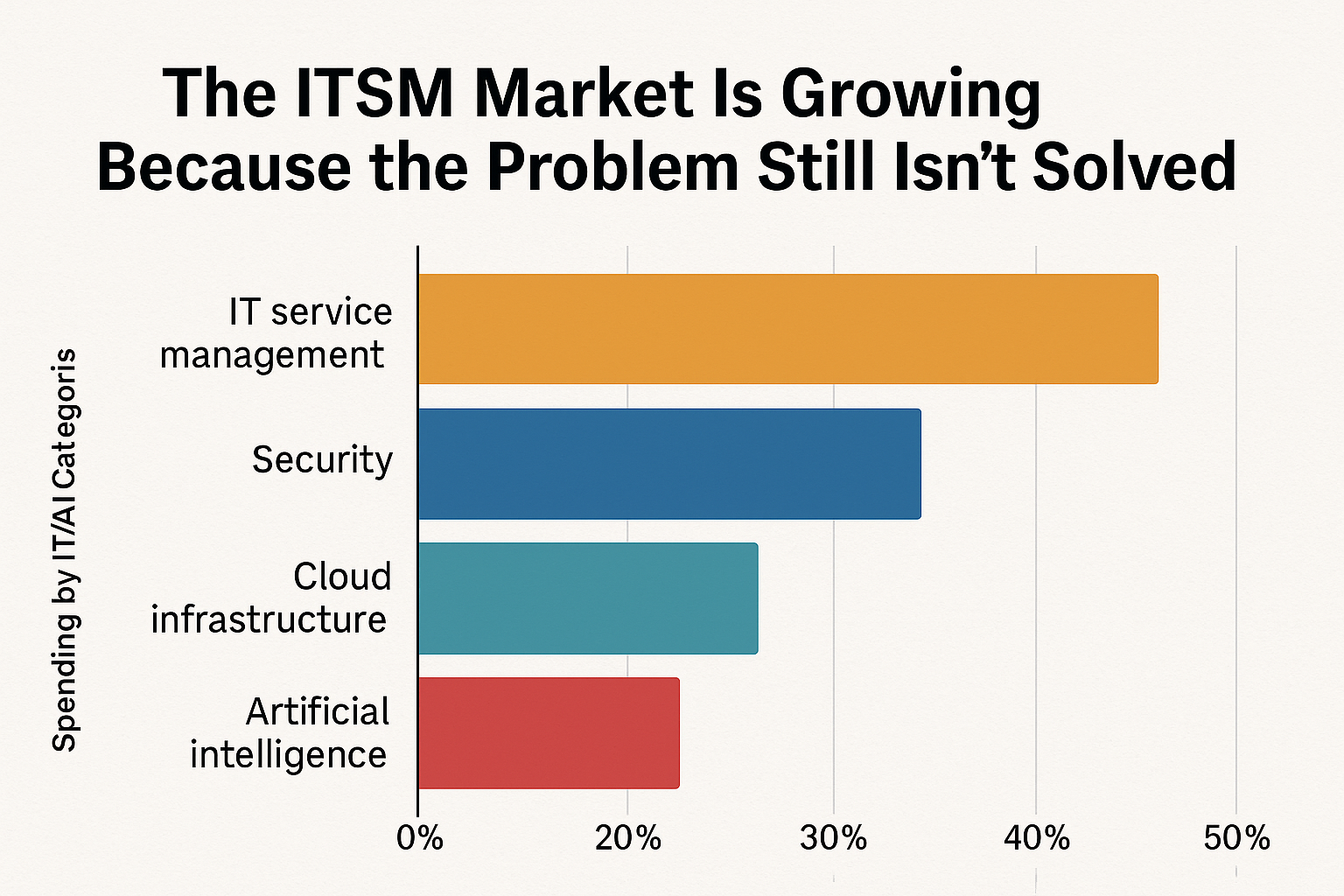

The ITSM market hit $11.91 billion in 2024 and projects to reach $36.78 billion by 2032.
That's 15% annual growth.
But here's what the numbers hide: 40% of organizations are replacing their ITSM systems, preparing for replacement, or reimplementing what they already bought.
When a market grows while nearly half its customers want out, you're watching compliance spending, not performance spending.
ITSM Became Theater
I saw this clearly during a 2019 audit with a 600-person logistics firm.
They'd spent half a million dollars on a major ITSM platform. The dashboards looked clean. Incident categories, SLA tracking, escalation trees—all color-coded and audit-ready.
Then we traced actual workflows.
80% of tickets were being resolved outside the system. Through Slack. Through hallway conversations. Through brute-force fixes that never touched the platform.
The COO told me: "We only use it when we have to. It's for the auditors."
That's when I understood. ITSM stopped being a performance layer. It became a compliance layer.
What Real Work Looks Like
When we shadowed their teams, the gap became obvious.
Context-rich decisions didn't fit into form fields. The system wanted rigid data: category, subcategory, urgency, asset tag. But real conversations were dynamic. "The sensor's throwing a false flag because of the firmware update last night—just revert and monitor." That took 30 seconds in Slack. Inside ITSM, it would've taken 10 minutes to document, route, and update.
Cross-department fixes had no home. When warehouse, logistics, and IT teams solved problems that cut across boundaries, the ITSM platform didn't know who "owned" it. Tickets bounced for days. In Slack, they'd tag the right engineer and resolve it before the platform even saw it.
Human judgment moved faster than process logic. Service desk workflows assume predictable inputs. Real ops teams deal in nuance. That gray area demanded conversation, not categories.
The platform punished velocity. Every quick fix had to be logged, categorized, closed, and audited. High performers looked noncompliant on paper. So the best people stopped documenting entirely. They'd fix it in Slack, tell their manager later, and move on.
ITSM became the graveyard for what already happened.
The Metrics Lie
Leadership saw 98% SLA compliance. Average resolution time under two hours. Zero backlog older than seven days.
But those metrics measured how fast people updated tickets, not how fast problems were solved.
The real work—the fixes that kept trucks rolling and systems online—never entered the system.
Executives saw compliance. Operations felt chaos.
Here's what broke:
Ticket velocity became a political metric. Teams learned to game the system. Delay ticket creation until the problem was nearly fixed. Categorize everything as "awaiting user response" to stop the clock. MTTR stopped measuring time-to-fix. It measured how clever teams were at manipulating workflows.
High performers looked worse. The fastest problem-solvers didn't open tickets at all. They used direct channels to resolve incidents instantly. Their numbers looked worse on paper—fewer tickets, fewer touches, lower SLA visibility. The better you were, the worse your metrics looked.
Rising ticket volume looked like productivity. When leadership saw ticket counts climb, they assumed systems were being used. In reality, high ticket volume meant friction was increasing. Employees spent more time documenting, less time delivering.
Why Agentic AI Changes the Equation
Traditional ITSM assumes: something breaks → a human opens a ticket → a human routes it → a human updates status.
That made sense in 2008.
In 2025, most of those steps can be observed, classified, enriched, and resolved by agents in real time.
But legacy ITSM still monetizes the human-in-the-middle.
Agentic systems flip that model. Instead of forcing context into forms, the system listens to the work—Slack threads, API logs, deployment data—and creates structured records automatically.
Where ITSM was built for control, agentic systems are built for coordination.
The difference shows up in one metric: decision latency.
How long between a signal and a verified business action?
Traditional ITSM runs in hours or days. Agentic systems operate in seconds or milliseconds.
I've seen one logistics client cut latency from 3.5 hours to under 90 seconds. That alone saved $4.8M in lost delivery productivity.
What Blocks Adoption
Organizations aren't failing to adopt agentic systems because they don't see the value. They're failing because their entire governance, procurement, and cultural DNA was built for control.
Procurement models still buy software like it's 2010. Most RFPs ask, "How many users does your platform support?" That question kills any agentic system before it starts. We don't sell seats. We sell outcomes. If your system doesn't fit the Excel template, you're disqualified.
Governance frameworks were designed for humans. ITIL, COBIT, ISO—all assume human accountability as the backbone of control. Every process maps to a person's name. Agentic systems operate on machine decisions within human oversight. Right now, there's no regulatory clarity on how to assign responsibility when an AI auto-resolves a network issue. So risk-averse organizations retreat to what's safe.
Middle management feels existentially threatened. Their identity is built on coordination: assigning tickets, running standups, reporting SLA compliance. When the system does that automatically, what's left? Their reflex is to resist under the banner of "data security" or "stability." But the truth is cultural. They don't want to lose the theater of control.
Data fragmentation makes agentic learning hard. Most enterprises run 30–70 disconnected SaaS tools, each with its own API, schema, and access control. Agentic systems thrive on unified telemetry. Fragmented data is the enemy of autonomy.
The Real Shift
Moving from ITSM to agentic operations requires a philosophical change.
You have to stop asking, "How do we control every step?"
And start asking, "How do we create a system that improves itself?"
That's an identity crisis for most organizations.
Control isn't safety. Adaptability is.
The work now produces its own telemetry. AI agents can make first decisions without waiting for a ticket. Policies can be enforced in real time, not in queues.
ITSM is organized around service intake. Agentic systems are organized around decision and execution.
When ops is AI-assisted, the ticket is just an artifact.
The money flowing into ITSM doesn't prove the model is healthy. It proves the market hasn't fully experienced what an agentic, business-wide operating system can do yet.
Once the first wave of companies shows that AI-led operations don't just work—they outperform—that dam breaks fast.
And when it does, every IT leader still clinging to human-centered control will find their service management looking a lot like service drag.