I need to tell you something uncomfortable.
Your sales team is drowning in work that isn't selling.
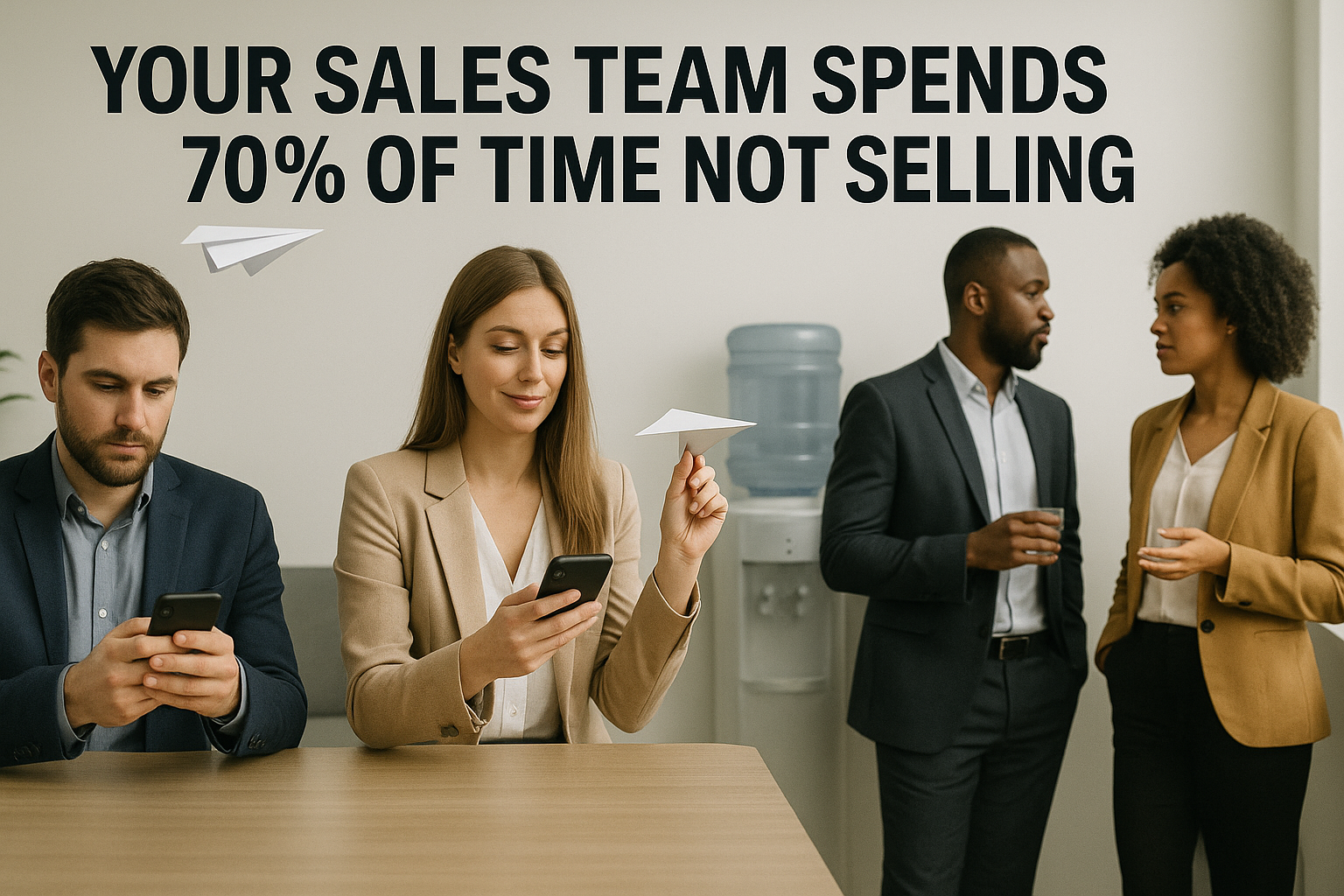
Research shows sales reps spend only 30% of their time actually selling. The other 70% disappears into what I call the invisible work loop.
And here's the part that stings: working harder won't fix it.
The Invisible Work Loop
I watched this play out with a company that had one of the most relentless sales teams I've ever seen.
Hundreds of calls. Social ads running constantly. Manual follow-ups on every lead.
But their close rates stayed flat. Margins kept shrinking.
On paper, it looked like a lead generation problem. Under the hood, it was something else entirely.
The sales team wasn't actually selling. They were spending 70% of their time chasing clarity.
Chasing clarity is the most expensive habit in business.
Here's what it looked like hour by hour:
8:00 a.m.: Reps spent the first hour piecing together their pipeline from emails, Slack messages, and spreadsheets that didn't match. Half the team called leads already contacted by someone else.
10:00 a.m.: They made calls with zero visibility into where leads came from or what problem they wanted solved. Generic conversations. Few conversions.
12:00 p.m.: Slack messages flying. "Can someone confirm if this order shipped?" "Do we have the new pricing sheet?" Every answer required human follow-up.
2:00 p.m.: Half the day gone. Deals stuck because someone was waiting on someone else. The rest of the afternoon spent rebuilding momentum that should never have been lost.
This team wasn't lazy. They were trapped in motion without advancement.
Every Slack message, every spreadsheet update, every manual report felt productive. But it was really just compensating for the absence of a real system.
The Diagnostic Question
Most sales leaders can't see the invisible work loop because everyone looks busy.
So here's the question that exposes it:
If your sales team stopped working for two days, would your pipeline move forward on its own, or would everything come to a dead stop?
If the honest answer is everything stops, you don't have a sales engine. You have a manual machine held together by human energy.
When you can't answer these questions cleanly, the system isn't running your business. People are:
How long does it take for a lead to move from first contact to proposal, and how many people have to touch it?
When a deal closes, how long before operations or finance knows it happened?
If I asked three different people for your current revenue forecast, would I get one number or three?
Your team isn't scaling. It's surviving.
And the cost of that survival is invisible burnout.
Systems vs. Hustle
Most sales leaders built their careers on being the hero. The one who stayed late. Hit quota no matter what. Saved the quarter with a last-minute deal.
That identity gets baked into their sense of worth.
So when I say the very behavior that made you successful is now holding your company back, it feels like an attack.
But here's the reframe: Hustle built your business. Systems will scale it.
The grind gets you from zero to something. From idea to traction.
But once a company crosses that $1M to $5M threshold, the same instincts that created growth start creating drag. What used to be momentum becomes maintenance.
You're still running on adrenaline when the business now requires architecture.
I show leaders their exhaustion as data. You worked 70 hours last week, but 40 of those hours were reactive. You're closing deals, but margins are shrinking. Your best people are burning out because the system only works when you're in the room.
Once they see their personal sacrifice as a business inefficiency, not a badge of honor, something shifts.
They realize they're not just tired. They're trapped inside the machine they built.
The 2026 Inflection Point
The shift to agentic AI is accelerating faster than most leaders realize.
Agentic systems don't just assist or generate content. They act autonomously. They observe business signals like leads, pipeline movement, and cash flow, then take action: reassigning leads, pausing campaigns, triggering renewal outreach.
They learn patterns and adapt over time rather than staying static.
Gartner predicts that by 2028, 60% of B2B seller work will be executed through conversational AI interfaces.
Microsoft reported a 67% productivity jump using an agentic AI agent in sales teams.
The technology isn't concept-stage anymore. It's delivering in real business contexts.
Companies that scale know they can't maintain manual heroics and exponential growth simultaneously. The pressure is on to move from people-power to system-power.
Early adopters win the structural advantage. Those who wait risk building around obsolete architectures.
The Uncomfortable Truth
If these systems can autonomously manage leads, trigger campaigns, and make operational decisions, what happens to sales roles?
Let me be direct: the number of traditional sales roles will shrink.
Not overnight, but structurally.
Once agentic systems can monitor intent signals, qualify leads, run follow-ups, and personalize outreach, you don't need the same headcount to cover pipeline volume.
One well-trained closer supported by AI agents can outperform an entire outbound team.
By 2026 to 2027, I expect 30% to 40% of frontline sales roles absorbed by automation. Fifty percent of remaining roles will be hybrid human-AI operators. The top 10% to 20% will evolve into sales strategists commanding premium salaries.
But here's what I wrestle with: every time we build a system that eliminates inefficiency, we realize the inefficiency was people. Good, loyal, hard-working people who gave their best to a system that stopped evolving before they did.
So yes, there's ethical weight to this.
But when I walk into a company drowning in manual admin and overworked teams, those people aren't thriving. They're burning out.
Automation doesn't kill their jobs. Broken systems already did, slowly.
What intelligent systems do is expose the reality. If a role can be replaced by automation, the company hasn't invested in that person's evolution. They've trapped them in repetition.
The goal isn't fewer people. It's smarter use of people.
We're not replacing humans. We're repurposing them into roles that require creativity, relationship depth, and judgment. Things machines still can't do.
The tragedy isn't job loss. It's human potential stuck in busywork.
Who You Make the Hero
The companies that successfully transition from manual heroics to intelligent systems versus those that fail comes down to one thing:
Who they make the hero.
The companies that fail make the software the hero. They sign the contract, run the demos, and expect the platform to fix their chaos.
But chaos is never a tech problem. It's a discipline problem disguised as a tech gap.
These companies plug systems into the same reactive culture. Six months later, they're still chasing reports, ignoring alerts, and wondering why the AI isn't helping.
Software amplifies whatever habits already exist. If you're disorganized, it scales your disorganization faster.
The successful ones rebuild identity first.
Before they automate anything, they change who the company believes the hero is.
They stop celebrating the firefighter who saves the day. They start celebrating the engineer who made the fire impossible in the first place.
They make clarity the KPI. They reward calm over chaos. They value decision speed over reaction speed.
When that shift happens, the technology finally has a culture it can breathe in.
The First Move
For the founder or sales leader who recognizes themselves in the invisible work loop, here's the first concrete step:
Run a Decision Audit for one day.
Tomorrow morning, before you open Slack or your inbox, open a blank page.
For the next eight hours, every time you make a decision, write down three things: what decision you made, what information you needed to make it, and where that information came from and how long it took to find.
By the end of the day, you'll have a brutal, factual map of how your business actually runs, not how you think it runs.
You'll see something you can't unsee: 60% to 80% of those decisions are repetitive, reactive, or dependent on data you had to chase down.
That's your invisible work loop quantified.
Highlight every decision that could be automated or system-assisted. Anything you had to wait on someone else for. Anything you had to recheck in multiple places. Anything that followed a clear pattern or threshold.
Those are your automation candidates. That list becomes the blueprint for your first workflow redesign.
Pick one choke point from your audit and commit to replacing that manual loop with a rule-based or AI-assisted process within seven days.
The goal isn't elegance. It's momentum.
When your team sees one loop disappear, they'll start spotting dozens more.
The Warning
If you wait until you're burned out to build a system, you'll build it from a place of exhaustion, not vision.
And exhausted leaders don't design intelligent systems. They design escape hatches.
Systems built in survival mode inherit chaos. Most founders don't start optimizing until the pain becomes unbearable. By that point, every solution is reactive.
The problem is you can't automate clarity you don't have.
The smartest companies start before the breakdown. They design systems as a strategy for freedom, not as a response to pain.
Hustle got you here. But if you keep fueling growth with human exhaustion, eventually you'll run out of humans.
There's a difference between momentum and motion. Momentum compounds. Motion just burns calories.
The biggest threat to a company over the next five years isn't competition. It's complexity.
Every new app, every disconnected workflow, every redundant process is silent corrosion on your time and margin.
AI won't save you from that unless you're disciplined about what not to automate.
Don't chase AI because it's trending. Build systems because you're done running your business from your inbox.
The real shift isn't from hustle to automation. It's from reaction to intention.
Hustle is loud. Systems are quiet.
And in the next era of business, it's the quiet companies, the ones that think faster than they move, that will win every time.